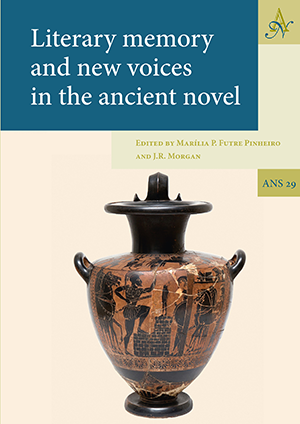

Bryan Reardon (1928-2009) was one of the most important and influential figures in the revival of scholarly interest in the Greek novel and ancient fiction in the last quarter of the twentieth century. His organisation of the first International Conference on the Ancient Novel (ICAN) at Bangor, North Wales, in 1976 was a landmark in the field and an inspiration to the organisers of subsequent ICANs, from which Ancient Narrative itself sprang. As editor of Collected Ancient Greek Novels (University of California Press 1989; second edition 2008), he made the Greek novels accessible to a wider readership and won a place for them in university syllabuses across the English-speaking world.
This volume contains twenty essays by leading scholars of ancient fiction, who were all pupils, colleagues or close friends of Bryan Reardon, in memory of his scholarship, energy, guidance and humanity. They cover a range of topics including ancient literary theory and the conceptualisation of fiction, discussion of individual novels (Chariton, Longus, Iamblichus, Achilles Tatius, and Apuleius) and novelistic texts (a papyrus fragment of a lost novel, and Philostratus’ Life of Apollonius), the afterlife of the ancient novel (in a Renaissance commentary on Roman law, in a seventeenth-century essay on the origin of the novel, and in a seventeenth-century series of paintings in a French château), and a speculative reconstruction of the morning after the end of Heliodorus’ novel. The title of the volume commemorates two of Bryan Reardon’s most important books: Courants littéraires grecs des IIe et IIIe siècles après J.-C. (Paris 1971) and The Form of Greek Romance (Princeton 1991); and the photograph of Aphrodisias on the front cover is a tribute to his critical edition of Chariton (2004).
Stephanie West
In Memoriam BPR v
Foreword xi
Dana F. Sutton
Bryan Peter Reardon: Vita et Scripta xiii
PART ONE
ASPECTS OF THE (GREEK) NOVEL
Gareth L. Schmeling
Narrative and the Ancient Novel:the human imagination is always a form of lying 3
Marília P. Futre Pinheiro
Thoughts on Diēgēma (Narratio) in ancient rhetoric and in modern critical theory 19
Consuelo Ruiz-Montero
Between rhetoric and orality:aspects of the spread of the earliest Greek novels 33
PART TWO
NOVELS AND NOVELTIES
Alain Billault
Histoire, mythologie, rhétorique et récit dans le roman de Chariton 51
Stephen M. Trzaskoma
Citations of Xenophon in Chariton 65
J.R. Morgan
‘A Cast of Thousands’: the riddle of the Antheia Romance solved (?) 81
Ewen Bowie
Λέξεις Λόγγου 99
Christopher Gill
Style and ethos in Longus’ Daphnis and Chloe 113
Hugh J. Mason
Hunters’ dedications: Longus and Lesbos 137
Ken Dowden
The plot of Iamblichos’ Babyloniaka: sources and influence 149
Giuseppe Zanetto
Love on the waves: the reversal of a topos in Achilles Tatius 173
Patrizia Liviabella Furiani
Furit Aestus: il meriggio in Filostrato e nei romanzi greci d’amore 185
Tomas Hägg†
The sense of travelling: Philostratus and the novel 213
PART THREE
APOGRAPHS AND ATTICISTS: ADVENTURES OF A TEXT
Louis Callebat
La prose des Métamorphoses d’Apulée: éléments d’une poétique 239
Maaike Zimmerman
Lucianic (and ‘un-Lucianic’) moments in Apuleius’ Metamorphoses 251
Gerald N. Sandy
Filippo Beroaldo’s use of Roman Law in his Commentary (1500) on Apuleius’ Golden Ass 269
Michael D. Reeve
History of a genre: Huet’s Origines des Romans 299
Kathryn Chew & Mark Benton
Heliodorus in France:Mosnier’s seventeenth-century representations of the Aethiopica 307
James Tatum
Who’s Afraid of Andromeda? 325
Abstracts 335
Contributors 343
Indices 349
Index locorum 349
General index 351