
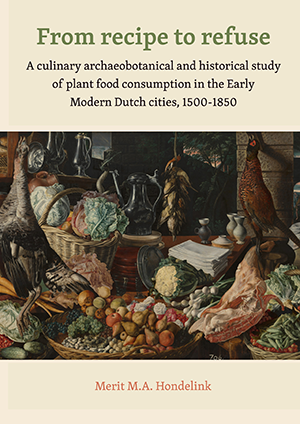
Past food practices are a tough nut to crack.
However, the reconstruction of the food prepared and consumed in Early Modern Dutch cities offers a compelling window into social, economic, and cultural life and the (subtle) changes it underwent through time. This dissertation aims to contribute to the reconstruction of the daily meal consumed in Early Modern Dutch cities by exploring plant-based food consumption practices. It does so by taking an multidisciplinary and methodological approach, integrating primarily archaeobotanical data from cesspits, historical culinary texts, and archival documents to shed light on what floral food items Dutch urban consumers ate and, by doing so, to assess if and how these patterns changed over time between 1500 and 1850 CE.
Introduction 1
2 The common and the rare: a review of Early Modern Dutch plant food consumption based on archaeobotanical urban cesspit data 7
3 A Multidisciplinary Analysis of Early Modern Plant Food Consumption Based on Vegetal Ingredients in Culinary Texts and Subfossil Plant Remains from Cesspits 23
4 Energy usage in the kitchen: Heat and material culture in sixteenth and seventeenth-century Dutch cookbooks 43
5 Sniffing out herbs and spices: Exploring the potential of volatile organic compounds in the archaeobotanical research of cesspits 61
6 Neither Monotonous nor Meagre: A Multidisciplinary Analysis of Food Consumption in Delft 69
7 General Discussion and Synthesis 103
Bibliography 121
Summary 145
Samenvatting 147
Acknowledgements 151