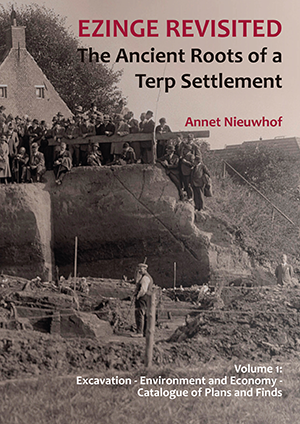
The excavations at Ezinge between 1923 and 1934 are among the most famous excavations in the history of Dutch archaeology. The excellent preservation of organic remains, especially the impressive remnants of houses from the pre-Roman Iron Age, attracted a great deal of attention even during the excavations. In northwestern European archaeology, Ezinge has for a long time been considered exemplary of a late-prehistoric settlement, and many publications still refer to it. Yet this excavation has never been published in full. Analysis of the wealth of data that the excavations in Ezinge provided was simply too complicated.
The analysis and publication of the excavation results has been resumed in 2011, now with the aid of databases and handmade local pottery as a fine dating instrument. This book, which will be published in two volumes, is written not only to reveal what was hidden in the archives, it also aims at presenting new insights into the habitation history of Ezinge and of terp settlements in general, by combining excavation results with the findings and interpretations of modern research.
This first volume describes the excavation itself, the salt marsh landscape that formed the natural environment of the terp settlements before embankment was undertaken in the Middle Ages, and the way the inhabitants made a living in this extreme natural environment. A major part of this volume is occupied by a catalogue of excavation plans with the accompanying finds and finds descriptions. Volume 2, which is due in 2021, is devoted to the buildings and the habitation history since the first settlers arrived around 500 BC, and will also describe and discuss what we can learn about ritual practice and social life from the Ezinge findings.
Preface 7
Prof. dr. Daan Raemaekers
1. Introduction 9
2. The excavations in the terp of Ezinge 13
2.1 The history of research 13
2.2 Method 19
2.3 After the end of the excavations 30
2.4 Dating 31
2.5 Some insights from earlier research 34
3. The natural environment 37
3.1 Introduction 37
3.2 The landscape 38
3.3 Botanical and diatom research 46
4. Making a living on the salt marsh 57
4.1 Water, food, and clothing 57
4.2 Raw materials and fuel 68
4.3 Social life 76
5. Catalogue of excavated levels 77
5.1 Excavation maps and photographs 77
5.2 Descriptions per find number 77
5.3 Dates 78
5.4 Illustrated objects 79
Levels A-V 81
Northern trench, Levels 1-4 261
Large sections A-M 275
References 303
Appendix 1 311
Water pits and wells at Ezinge
Appendix 2 315
Concordances of house numbers and sunken hut numbers
A. Houses 315
B. Sunken huts 317